


So much of what I write about is living in the now. Enjoying real human interaction. Sharing experiences with family and friends. Life is all about relationships, and nothing I’m about to say changes that.
So where does artificial intelligence, which seems like the exact opposite of all of that, fit in? It fits because AI is a tool, and a good tool can make almost anything you’re working on better. You now have a PhD-level consultant in your pocket at all times, ready whenever you need it.
I hear the pushback all the time. AI is going to take over my life. No, it’s not. Used the right way, it can make your life better, and the key word is tool.
The Nail Gun
I’ve been in construction my whole adult life, and I can remember when nail guns first showed up on job sites. I was in college, and my brother was working as a framer. He’s an early adopter of most things, and he was certainly an early adopter of the nail gun. He showed up to work with his framing crew carrying one, while every other guy had a hammer and a pouch of nails. They looked at him like he was crazy, and they all had their reasons it wouldn’t work. It’ll miss where the nail is supposed to go. You’ll shoot yourself in the hand. He ignored them and started nailing away.
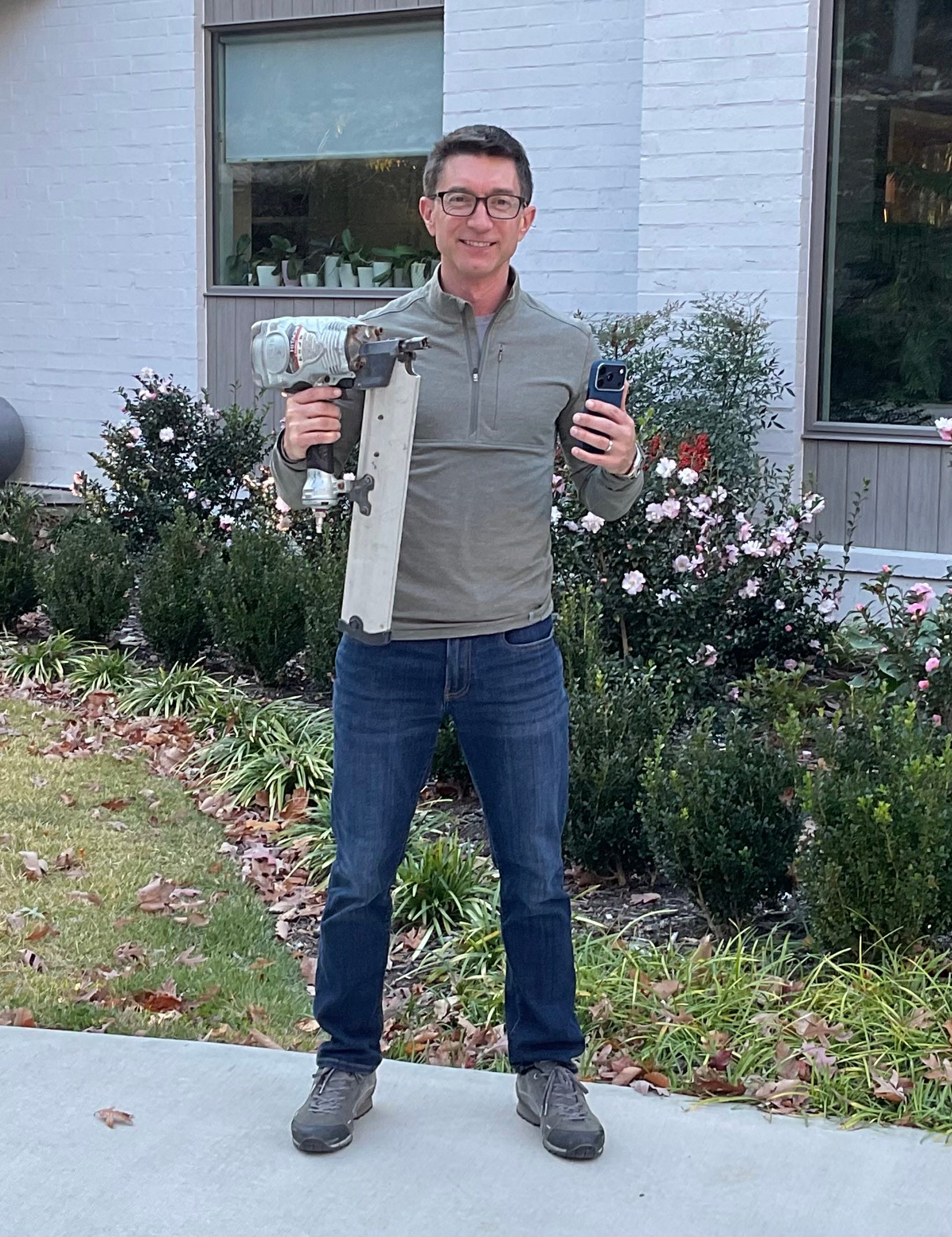
By the end of the week, he was framing faster than the rest of the six-man crew combined. Within a month, the owner of the framing company was buying nail guns for everyone else on the crew. Today, every framing crew uses them, and if you don’t, you’re out of business. It’s simply too good of an efficiency tool to ignore.
AI is the same. It isn’t going to replace you or your job, but somebody using AI is going to be better at your job than you are.
The Rain Man Problem
But AI makes mistakes. Yes, it does, and it’s worth understanding how.
Our family recently watched Rain Man, the Tom Cruise and Dustin Hoffman classic. In one scene, Dustin Hoffman’s character, Raymond, is asked to solve complex math problems in his head. He rattles off answers like the square root of 2,130, which he gives as 46.15192304. Tom Cruise’s character is amazed and says he should be working for NASA. Then the doctor asks Raymond how much a candy bar costs. “’Bout a hundred dollars.” And how much does one of those new compact cars cost? Same answer: “’Bout a hundred dollars.”
Raymond could handle unbelievably complex math and then stumble over things most of us find easy. That scene reminded me of AI. It can analyze a 100-page contract for me in seconds, but it can also trip over something simple.
My son wanted to know whether he had hung his American flag properly in his room, so I took a picture and asked AI. It gave me the whole history of the flag along with how it should be displayed and cared for. It correctly said the blue field with the stars belongs in the upper left corner, which is exactly where ours was. Then it told me we needed to flip it. I explained that the stars were already in the upper left, and it kept insisting the flag needed to be reversed. It knew the rule perfectly. It just couldn’t tell left from right.
Another time, I wanted to watch a SpaceX launch that I knew was scheduled for 6:30. By 6:50, nothing had happened, so I asked AI whether I had missed it. It told me the rocket had launched at 7:04 and the mission was a success. It was 6:50. When I pushed back with the actual time, it corrected itself. I was right; the launch was confirmed for 7:04, but it hadn’t happened yet.
So AI is amazing, but like any tool, it needs someone operating it. A nail gun can set nails all day long, but it still takes a framer to decide where they go and to notice when one misses. You bring the judgment, and AI brings the speed.
Putting AI to Work in the Big Three
I talk a lot about the big three areas of life you need to take control of: health, money, and relationships. AI can help with all three.
A quick note before I get into it. I love Claude and pay for the $20-a-month version. The biggest reason is projects, which let me batch everything related to one subject into its own bucket, so the AI already has the background every time I come back.
Health
I created a project called Health and put all of my health information in it. I downloaded every doctor’s report from my medical portals, every blood test, and every other health-related test I’ve had, like DEXA scans and VO2 max testing. Then I asked it to review everything. It goes deep. It spots trends over time and gives me good questions and items to bring up with my doctor at my next visit.
Let’s face it, doctors only have a limited amount of time with you, and they likely don’t have access to everything from every other provider you see. AI doesn’t replace your doctor. It helps you prepare, so your doctor can help you better.
You can also ask AI to build a workout routine around whatever you want to improve, suggest diet adjustments to hit your goals, or estimate the nutrition in a meal from a photo of your plate. The list goes on.
Money
This is where AI can put real money back in your pocket. Start by uploading a few months of credit card statements and asking it to show you where your money is actually going. Have it pull out every subscription you’re paying for, because most people are surprised by how many they’ve forgotten about. Then ask it to flag the waste you can cut. It’s rarely one big purchase that does the damage. It’s the small, routine expenses like the streaming service you never watch, the app that auto-renews, or the daily takeout, and they quietly add up over time.
Remember, the second step of my three-step formula for getting rich is to spend less than you make. AI can show you exactly where to start, and it takes minutes instead of a weekend with a spreadsheet.
From there, upload your investment statements and ask it to break down your allocation, flag funds that overlap, and show you how much you’re paying in fees. Ask it to explain a stock or a company’s latest earnings in plain English, or to stress-test a decision, like paying down your mortgage versus investing the difference. The same rule applies here as everywhere else. AI is a great analyst, but you’re still the one making the decision. Use it to get smarter and ask better questions, then make the call yourself, ideally alongside a professional you trust.
Relationships
This one might seem the most surprising, since relationships are the most human part of life. But AI isn’t there to replace the time you spend with people. It’s there to help you create more of it. When you’re more efficient with everyday tasks at work and at home, you free up time to spend on what really matters. Remember, time is your most valuable asset.
I also use it to plan the things that really matter, like family experiences. I keep a project called Vacations that knows who’s going, what we like to do, and how much time we want to spend on each activity, and it builds an hour-by-hour plan for the whole trip. The hours I used to spend researching and coordinating are now hours spent actually enjoying the trip with the people I love. The same goes for smaller things, like coming up with date night ideas, planning a birthday, or finding a gift that actually fits the person.
Pick Up the Tool
Back to the nail gun. My brother didn’t stop being a framer when he picked up that tool. He became a better one, and he got his time back. That’s how I think about AI. Let it do the heavy lifting on research, analysis, and planning, so you can spend more of your life on the things no machine can do for you, like being present with the people you love.
Start Bold
Pick one area of your big three this week and put AI to work on it. Upload your last three months of credit card statements and ask what you can cut, gather your recent health records and ask what questions you should bring to your next appointment, or hand it your next family trip and let it build the plan. Start small, check its work, and see how much time you get back.
Your Turn
How do you use AI to free up more time to spend doing the things you truly love? Drop it in the comments. I’d love to hear what’s working for you.
Minor in money. Major in life.
Don’t drift. Live boldly.

The BOLD Life is for people who want to build wealth without losing themselves in the process - people who want their success to strengthen their health, relationships, purpose, and freedom rather than compete with them. If that’s the life you’re building, you’re in the right place. New here? Start with The Blueprint of a BOLD Life, then read whatever draws your attention. Every post stands on its own.
If you enjoyed this week’s content, please share it with a friend.
A Favor
If you enjoy this content, click the 💚 below. It takes two seconds, and it helps more people find these posts. Thank you.
Gracias Chris,
Keyword: Tool ... >;o)
Copilot has been very helpful is analyzing and organizing information.
I am a slow adopter of AI for personal aspects but like your approach for health.
Carlos